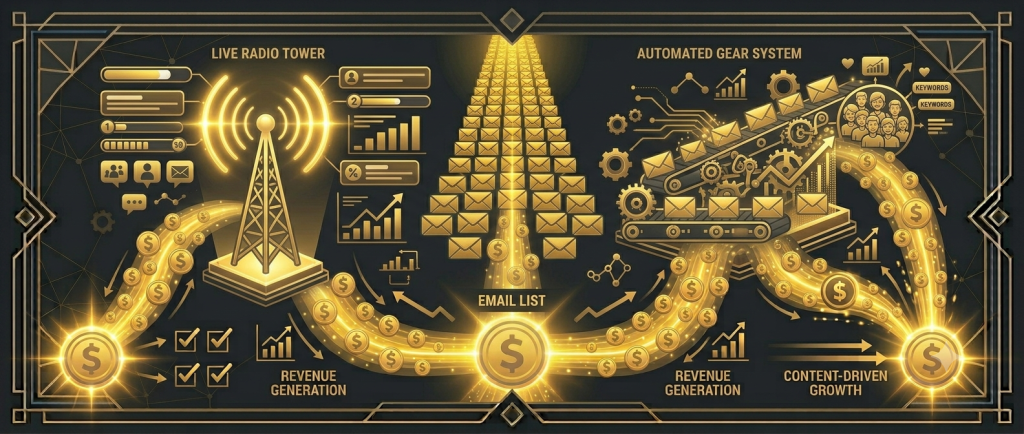

Broadcast vs. Automation — How to Use Both Effectively
If you’ve spent any time inside an email marketing platform, you’ve encountered two fundamentally different ways of sending emails to your list. The first is the broadcast — a one-time email sent manually to your entire list or a segment of it at a specific point in time. The second is automation — a pre-written sequence of emails that gets triggered by a subscriber action and delivered on a predetermined schedule without any ongoing involvement from you.
Most beginners start with one and ignore the other. Some send only broadcasts and never build the automated infrastructure that generates revenue while they sleep. Others set up a welcome sequence, call their email marketing done, and never develop the broadcast habit that keeps their list warm, engaged, and responsive to real-time promotions.
Both approaches leave significant money and relationship equity on the table. The most effective email marketing strategies use broadcasts and automation in combination — each doing the specific jobs it’s best suited for, working together to build relationships and generate revenue in a way that neither can accomplish alone.
This post is going to give you a complete understanding of both, when to use each one, and how to build a system that integrates them effectively.
Understanding Broadcasts
A broadcast is a single email sent to your list — or a defined segment of it — at a specific moment in time. You write it, schedule it or send it immediately, and every subscriber who receives it gets the same message at roughly the same time.
Broadcasts are the real-time voice of your email marketing. They connect your business to what’s happening in the world right now — a new product launch, a time-sensitive promotion, a trending topic in your niche, a personal story from your week, a reaction to something happening in the industry. They create the sense that there’s a real, active human being behind the email address — someone who is present, engaged, and paying attention to the same things their subscribers are.
The primary strength of broadcasts is their immediacy and relevance. A broadcast sent on a Monday morning referencing something that happened over the weekend feels alive in a way that a pre-written automated email never can. That freshness is a significant engagement advantage — it creates the sense of a real, ongoing conversation rather than a pre-recorded message playing on a loop.
Broadcasts are also the primary vehicle for time-sensitive promotions. Launch announcements, limited-time offers, cart close reminders, flash sales — all of these require the timing precision and real-time delivery that only a broadcast can provide. Automated sequences are excellent for evergreen offers, but anything with a genuine deadline needs the flexibility of a broadcast.
The primary limitation of broadcasts is that they require ongoing effort. Every broadcast has to be conceived, written, and sent by a real person on a real schedule. If you stop creating broadcasts, your list stops receiving timely content — which is why the broadcast habit needs to be built and maintained as a consistent business practice rather than an occasional activity.

Understanding Automation
An automated email sequence — sometimes called an autoresponder sequence — is a series of pre-written emails that gets triggered by a specific subscriber action and delivered on a schedule you define in advance. The most common trigger is the opt-in — when someone joins your list, they’re automatically enrolled in your welcome sequence. But triggers can also include clicking a specific link, purchasing a product, visiting a particular page, or reaching a specific date or anniversary.
The primary strength of automation is its scalability and consistency. Once you’ve written and configured an automated sequence, it delivers the same carefully crafted experience to every subscriber who triggers it — whether that’s the tenth subscriber this month or the ten-thousandth subscriber two years from now. You do the work once, and it compounds in value indefinitely.
Automation is the infrastructure that allows your email marketing to function around the clock without your active involvement. While you’re creating content, traveling, or sleeping, your automated sequences are welcoming new subscribers, nurturing prospects, and presenting offers to people who are ready to buy — all without requiring a single action from you after the initial setup.
Automated sequences are also exceptional for delivering content in a specific, intentional order. An educational sequence that walks subscribers through a topic progressively — from foundational concepts to advanced strategies — requires a structured delivery that broadcasts can’t provide. The subscriber’s experience unfolds in the order you designed, regardless of when they joined.
The primary limitation of automation is its static nature. A pre-written sequence cannot respond to current events, react to breaking news in your niche, or reflect the evolving personality and perspective of a real person navigating real circumstances. Without regular updates and refreshes, automated sequences can start to feel dated — a problem that compounds the longer a sequence runs without revision.
The Four Core Automated Sequences Every Email Marketer Needs
While automation can be applied to virtually any subscriber journey, there are four sequences that form the foundation of a robust email marketing infrastructure.

The Welcome Sequence The welcome sequence is the first and most important automated sequence in any email marketing system. As we covered in a previous post, it delivers the lead magnet, introduces your brand, provides standalone value, makes a soft offer, and sets expectations for the ongoing relationship — all in a five to seven email sequence triggered at the moment of opt-in.
Every subscriber who joins your list, regardless of when they join or what brought them to you, receives the same carefully crafted introduction to your brand. That consistency of onboarding experience is a significant competitive advantage that manual broadcasting alone could never replicate at scale.
The Nurture Sequence Following the welcome sequence, a nurture sequence continues the relationship-building process through a longer series of value-focused emails that deepen the subscriber’s understanding of your perspective, build trust in your expertise, and gradually introduce your core offers over a period of weeks or months.
A well-built nurture sequence effectively automates what would otherwise require months of consistent broadcasting to achieve — moving a new subscriber from awareness to genuine engagement to buying readiness through a progression of content experiences delivered in a specific, intentional order.
The Promotional Sequence A promotional sequence is an automated series triggered by a specific event — typically a subscriber clicking a link that indicates interest in a particular offer, or a subscriber entering a specific segment based on their behavior. It delivers a focused sequence of emails designed to convert interested prospects into buyers through a combination of value, social proof, and urgency.
Unlike a broadcast launch sequence — which sends every subscriber the same promotional emails simultaneously — an automated promotional sequence works on each subscriber’s individual timeline, triggering when they express relevant interest rather than when you choose to promote.
The Re-Engagement Sequence Over time, a portion of every email list becomes inactive — subscribers who stop opening emails, clicking links, or engaging with content. A re-engagement sequence automatically identifies these subscribers and delivers a targeted series of emails designed to rekindle their interest before they’re removed from the active list.
A simple three to five email re-engagement sequence — acknowledging the silence, offering something new and valuable, and ultimately asking whether the subscriber still wants to hear from you — can recover a meaningful percentage of lapsed subscribers and helps keep your list clean and your engagement metrics healthy.
How Broadcasts and Automation Work Together
The most effective email marketing systems use broadcasts and automation as complementary layers of the same overall strategy — each handling the specific tasks it’s best suited for.
Think of automation as the foundation and broadcasts as the ongoing conversation built on top of it.
Your automated sequences handle the consistent, scalable work — onboarding new subscribers, nurturing leads through a progression of value, and presenting evergreen offers to people who are ready to buy. This foundational layer runs continuously in the background, working for every subscriber on their individual timeline without any ongoing effort from you.
Your broadcasts handle the real-time, relationship-building work — sharing current insights, promoting time-sensitive offers, reacting to events in your niche, and maintaining the human presence that keeps your list engaged and trusting over the long term.
A subscriber who joins your list goes through your automated welcome and nurture sequences, building a relationship with your brand on their own timeline. Meanwhile, they’re also receiving your regular broadcasts, which connect them to the current, real-time version of your business. Both streams of communication work together to create a subscriber experience that feels both consistent and alive — structured and spontaneous, automated and human.
Building Your Integrated Email System
Here is a practical roadmap for building an email system that leverages both broadcasts and automation effectively.
Phase 1: Build the Foundation Set up your welcome sequence — five to seven emails covering delivery, story, value, soft offer, and expectations. This is your minimum viable automation infrastructure and should be the first thing you build after choosing your email platform and creating your lead magnet.
Phase 2: Establish the Broadcast Habit Commit to a consistent broadcast schedule — at minimum, one email per week — and maintain it regardless of what else is happening in your business. This is your ongoing relationship maintenance and the primary way you stay relevant and present for subscribers who are past the welcome sequence.
Phase 3: Build the Nurture Sequence Once your welcome sequence and broadcast habit are established, build a longer nurture sequence — ten to twenty emails that extend the onboarding journey and continue the value delivery started in the welcome sequence. This can be built gradually — adding two or three emails at a time — rather than all at once.
Phase 4: Add Promotional Automation Build automated promotional sequences for your core offers — a sequence that triggers when a subscriber expresses interest in a specific product or topic, delivering a focused series of emails designed to convert that interest into a sale.
Phase 5: Implement Re-Engagement Set up a re-engagement sequence that automatically targets subscribers who have gone inactive — reducing list decay and maintaining the health of your overall email metrics.
A wide motivational banner illustration of a well-designed control room with two distinct panels — a live broadcast console on the left with real-time signal indicators, and an automated sequence dashboard on the right with flowing scheduled email icons — both being monitored by a single confident figure, representing the integrated mastery of broadcast and automation. Dark background, gold tones, flat editorial style, professional and compelling.

The Bottom Line
Broadcasts and automation are not competing strategies — they are complementary tools that work together to create an email marketing system greater than the sum of its parts.
Automation provides the scalable, consistent foundation that works for every subscriber on their individual timeline. Broadcasts provide the real-time human presence that keeps the relationship alive, relevant, and engaging over the long term.
Build both. Use both consistently. And let the combination do what neither can accomplish alone — building a list of deeply engaged subscribers who trust your voice, value your content, and buy your recommendations reliably over time.
Check out the latest tools, tutorials, and resources for building your email marketing system at Profit With Bob — and grab your free resource to help you get started today. Grab it here.