
The Difference Between Active Income and Passive Income Online
Few concepts in the online business world generate more excitement — or more confusion — than passive income. It’s the dream that draws millions of people into the world of internet marketing every year. The idea that you could build something once, walk away, and continue collecting income while you sleep, travel, or spend time with the people you love is genuinely compelling.
And here’s the thing — it’s real. Passive income online is not a myth. But the way it’s typically presented creates a distorted picture that sets most beginners up for frustration before they ever get started. Understanding the true difference between active and passive income — and how the two relate to each other — is one of the most important mindset shifts you can make as you build your online business.
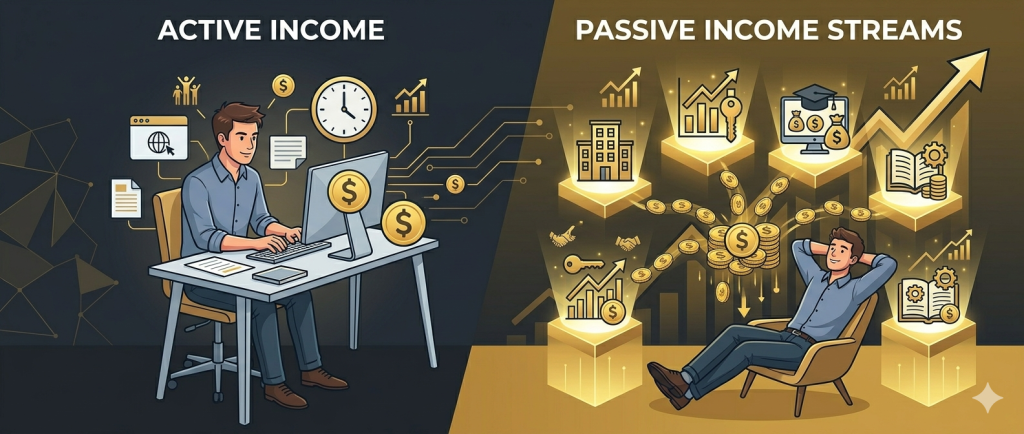
Active Income: Trading Time for Money
Active income is exactly what it sounds like. You work, you get paid. You stop working, the income stops. This is the model most people are familiar with from traditional employment — you show up, you put in the hours, you receive a paycheck.
In the online world, active income takes many forms:
- Freelancing — Writing, graphic design, web development, social media management, or any other service you provide to clients on a project or hourly basis.
- Coaching and consulting — Getting paid for your time and expertise in one-on-one or group settings.
- Done-for-you services — Building funnels, managing ad campaigns, or producing content for other businesses in exchange for a fee.
- Live launches — Hosting webinars, running promotions, or actively selling during a defined launch window.
Active income is not inferior to passive income — in fact, for many online business owners, it’s the fastest path to generating meaningful revenue. The skills you develop providing active income services also tend to make you a better marketer, better content creator, and better business operator overall.
The limitation of active income is its ceiling. There are only so many hours in a day, and your income is directly tied to how many of them you can productively fill. Scaling active income typically requires either raising your rates or hiring people to deliver the work on your behalf — which introduces a whole new level of complexity.
Passive Income: Building Assets That Pay You Repeatedly
Passive income, in contrast, comes from assets you’ve built that continue generating revenue without requiring your ongoing active involvement. The key word here is assets. Passive income is asset income.
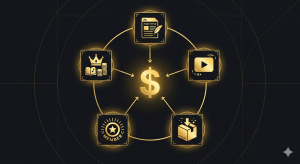
In the online world, passive income streams include:
- Affiliate marketing through evergreen content — A blog post or YouTube video that continues to rank in search results and generate clicks on affiliate links months or years after it was created.
- Digital products — An ebook, template pack, or course that can be purchased and delivered automatically without any involvement from you.
- Membership sites — A recurring subscription that charges members monthly or annually and delivers content or community access automatically.
- Ad revenue — Monetized YouTube videos or display ads on a blog that generate income based on traffic volume.
- Licensing and royalties — Income from content or intellectual property that others pay to use.
The appeal of passive income is obvious. Once the asset is built and the systems are in place, it generates revenue whether you’re at your desk or on a beach somewhere. It’s not tied to your time — it’s tied to the value of the asset itself.
The Critical Misconception About Passive Income
Here is where most of the confusion — and disappointment — comes from. Passive income is almost universally presented as though it requires no work. Build it once, collect forever. Set it and forget it.
That framing is dangerously misleading.
Every passive income stream requires significant active work upfront. The blog post that generates passive affiliate commissions had to be researched, written, optimized, and promoted before it ever earned a cent. The course that sells on autopilot had to be planned, recorded, edited, and loaded onto a platform before the first sale happened. The YouTube video collecting ad revenue had to be scripted, filmed, and published — and in most cases, it took months of consistent publishing before the channel had enough authority for any individual video to generate meaningful income.
Passive income is not the absence of work. It is the result of work done in advance, producing returns that extend far beyond the effort required to create it. Think of it as deferred payoff — you invest the effort now and collect the dividends later, repeatedly, for an extended period.
That reframe changes everything. It means passive income isn’t about avoiding work — it’s about doing work that compounds. And understanding that distinction is what separates the people who actually build passive income streams from those who chase the idea of them indefinitely.
How Active and Passive Income Work Together
One of the most important things to understand about building an online business is that active and passive income are not opposites or alternatives — they are complementary phases of the same journey.
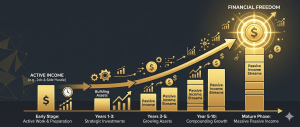
For most online business owners, the progression looks something like this:
In the early stages, active income dominates. You might be freelancing, offering services, or doing live launches to generate immediate cash flow while you build your platform. This active income funds your life and your business while your passive income assets are still under construction.
As your content library grows, your email list expands, and your digital products and affiliate offers gain traction, passive income begins to contribute meaningfully. Initially it might be a small supplement to your active income. Over time, as your assets compound, the passive income grows while the active effort required to maintain it stays relatively flat.
Eventually — for those who build consistently and strategically over a long enough period — passive income can exceed active income entirely. At that point, active work becomes optional rather than necessary, and the business truly begins to run on the energy of accumulated assets rather than ongoing labor.
Practical Examples of Each
To make this concrete, here are side-by-side examples of active versus passive income in common online business scenarios:
Affiliate Marketing: Active — manually emailing your list with a time-sensitive promotion, requiring you to write and send the campaign yourself. Passive — an automated email sequence promoting an affiliate offer that every new subscriber receives, generating commissions without your involvement after the initial setup.
Content Creation: Active — creating a new YouTube video or blog post that drives immediate traffic and sales. Passive — that same video or blog post continuing to rank in search results and generate affiliate clicks two years after you published it.
Products: Active — hosting a live webinar to sell a course to a new audience. Passive — that same course available on your website with an automated sales page and email sequence selling it to new leads every day.
Building Your Passive Income Foundation
If passive income is the goal — and for most online business owners, it is at least part of the goal — the path there is straightforward even if it isn’t quick.
Start by building your platform and your email list. Every subscriber you add is a potential future buyer of every passive income asset you’ll ever create. Then create your first passive income asset — whether that’s a set of evergreen blog posts, a simple digital product, or an automated affiliate email sequence. Build the infrastructure to deliver and sell it automatically. Then drive traffic to it consistently until it’s generating reliable revenue.
Then do it again. And again. Each new asset adds another stream. Each stream compounds. Over time, the accumulated result is an income that doesn’t stop when you do.

The Bottom Line
Active income gets you started. Passive income sets you free. But passive income doesn’t happen without active effort — it just shifts when that effort takes place. Front-load the work, build the assets, and let compounding do what it does best.
The most successful online business owners understand that the goal isn’t to avoid working. It’s to work on things that keep paying you long after the work is done.
That distinction is worth everything.
Want weekly strategies for building both active and passive income online? Join the Profit With Bob newsletter — practical, no-fluff content delivered straight to your inbox every week. [Subscribe here.]