
What Is a Sales Funnel and Why Does Every Online Business Need One?
If you’ve spent any time in the online marketing world, you’ve heard the term sales funnel thrown around constantly. It’s one of those phrases that gets used so frequently — and so casually — that many beginners assume they already understand it without ever stopping to examine what it actually means or why it matters so much.
Here’s the truth: understanding sales funnels is not optional if you want to build a profitable online business. It is one of the most foundational concepts in all of digital marketing, and the businesses that implement them well consistently outperform those that don’t — often by a dramatic margin.
This post is going to give you a clear, practical understanding of what a sales funnel is, how it works, and why your online business genuinely cannot afford to operate without one.
The Simple Definition
A sales funnel is the journey a potential customer takes from the moment they first become aware of you and your brand all the way through to making a purchase — and ideally, becoming a repeat buyer.
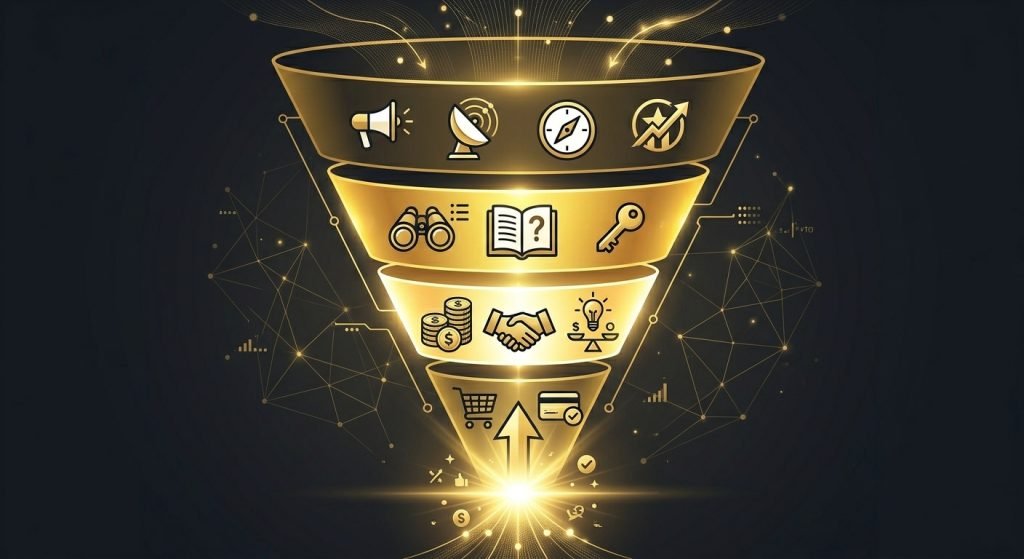
The word “funnel” is a visual metaphor. At the top of the funnel, you have a large number of people — casual browsers, first-time visitors, people who clicked a link on social media or found you through a Google search. As they move through the funnel, some of them drop off at each stage, and the ones who remain become progressively more engaged, more trusting, and ultimately more likely to buy.
By the time someone reaches the bottom of the funnel, they are not just aware of you — they understand what you offer, they trust your recommendations, and they’re ready to take action.
Why a Funnel Beats Random Marketing
Without a funnel, most online businesses operate in what I’d call random marketing mode. They create content, post on social media, maybe run some ads, and hope that the right people see the right message at the right time and decide to buy. Sometimes it works. Most of the time it doesn’t — and there’s no systematic way to understand why, or how to improve it.
A sales funnel changes everything by turning that random process into a deliberate, measurable system. Instead of hoping people find their way to your offer, you guide them through a structured sequence of steps — each one designed to build trust, deliver value, and move them closer to a buying decision.
The difference between a business with a funnel and one without is the difference between a store with a sales team and one with an empty showroom. The product might be identical. The outcome is dramatically different.
The Four Core Stages of a Sales Funnel
While funnels can vary significantly in complexity depending on the business, most follow a four-stage framework:
Stage 1: Awareness This is the top of the funnel — the point at which someone discovers you for the first time. Awareness comes from blog content ranking in search engines, YouTube videos being discovered through the algorithm, social media posts being shared, or paid ads reaching a targeted audience. At this stage, the visitor knows nothing about you. Your only job here is to make a strong enough first impression that they want to learn more.
Stage 2: Interest Once someone is aware of you, the next goal is to convert that awareness into genuine interest — and the most powerful way to do that is to get them onto your email list. This typically happens through a lead magnet — a free resource offered in exchange for their email address. A well-designed lead magnet delivers immediate value, establishes your credibility, and opens a direct line of communication that you control.
Stage 3: Decision With your new subscriber on your email list, you now have the opportunity to nurture that relationship through consistent, valuable content. Over time — through your email sequences, blog posts, videos, and recommendations — your subscriber develops enough trust to seriously consider buying from you. This is the decision stage, where they evaluate your offer and weigh it against their alternatives.
Stage 4: Action The action stage is the conversion — the moment your prospect becomes a buyer. But a well-built funnel doesn’t stop here. After the initial purchase, additional offers — upsells, cross-sells, and complementary products — give your new customer the opportunity to go deeper with you and increase their results. This is where the real profitability of a funnel becomes apparent.

The Anatomy of a Basic Online Marketing Funnel
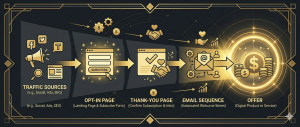
Let’s make this concrete by walking through what a simple but effective online marketing funnel actually looks like in practice.
It starts with a traffic source — a blog post, a YouTube video, or a social media post — that attracts a targeted visitor. That visitor lands on an opt-in page where they’re offered a compelling free resource in exchange for their email address. After opting in, they’re taken to a thank-you page — which can also serve as the first monetization point by presenting a low-cost offer relevant to what they just signed up for.
They’re then enrolled in an email welcome sequence that delivers value, builds rapport, and introduces your paid offers naturally over several days or weeks. As the relationship deepens, your email broadcasts and follow-up sequences continue to present relevant offers — affiliate products, your own courses, membership programs — to a warm audience that already knows and trusts you.
That is a complete, functional funnel. And every element of it can be built with the basic toolkit we discussed in a previous post — an email platform, a simple landing page, and a lead magnet.
Why Every Online Business Needs One
Whether you’re an affiliate marketer, a course creator, a blogger, or a coach, a sales funnel is the infrastructure that makes your business work systematically rather than accidentally.
Here’s what a funnel does for your business specifically:
- It captures leads you would otherwise lose. The vast majority of first-time visitors to any website will never return. A funnel — specifically an email opt-in — gives you a way to maintain the relationship even after they’ve left your site.
- It automates your marketing. Once your funnel is built and your email sequences are in place, the system works for you around the clock — nurturing leads, building trust, and presenting offers without requiring your active involvement for every transaction.
- It maximizes the value of every visitor. Instead of hoping a one-time visitor becomes a buyer, a funnel systematically moves them through a journey designed to maximize the probability of a purchase — and the value of that purchase when it happens.
- It makes your business measurable. A funnel gives you specific metrics to track — opt-in rates, email open rates, click-through rates, conversion rates — so you can identify exactly where people are dropping off and make targeted improvements.
- It scales. Whether you have ten visitors a day or ten thousand, your funnel processes them all through the same system with the same consistency. That scalability is what separates a real online business from a content hobby.
Keeping It Simple to Start
One of the most common mistakes beginners make when they learn about sales funnels is immediately trying to build something elaborate — multiple upsells, complex automation sequences, split tests across every page. That complexity is appropriate for a mature business with established traffic and proven offers. It is not appropriate for day one.
Start with the simplest possible funnel that works. One traffic source. One opt-in page. One lead magnet. One welcome email sequence. One core offer. Get that working first — get real subscribers on your list and real conversions happening — and then add complexity strategically based on what your data tells you.
A simple funnel that works is infinitely more valuable than a complex funnel that never gets finished.

The Bottom Line
A sales funnel is not a gimmick, a buzzword, or a tactic reserved for sophisticated marketers with big budgets. It is the fundamental system through which every successful online business converts strangers into subscribers, subscribers into buyers, and buyers into repeat customers.
If you are operating without one, you are leaving an enormous amount of money — and an enormous number of relationships — on the table every single day.
Build the funnel. Start simple. Refine over time. And let the system do the work that random marketing never could.
If you’re ready to take your online business to the next level, check out the latest resources and recommendations at Profit With Bob — including everything you need to build your first funnel the right way. Grab it here.