How to Choose Your First Profitable Niche

Heads up: this post may contain affiliate links. If you buy through them, I may earn a commission at no extra cost to you. I only recommend what I’d use myself. Full disclosure
How to Choose Your First Profitable Niche
If you’ve decided you want to build an online business, congratulations — you’ve already made one of the most important decisions of your life. But almost immediately, most people run into the same wall: What should my business actually be about?
Choosing a niche is the foundational decision that everything else is built on. Get it right, and you have a focused, motivated audience ready to engage with your content and buy your recommendations. Get it wrong — or worse, spend months paralyzed trying to decide — and you’ll find yourself spinning your wheels before you’ve even started.
The good news is that choosing a profitable niche doesn’t have to be complicated. There’s a clear process, and this post is going to walk you through it.
What Is a Niche and Why Does It Matter?
A niche is simply a focused segment of a broader market. “Health” is a market. “Weight loss for women over 50” is a niche. “Personal finance” is a market. “Getting out of debt on a single income” is a niche.
The more specific you are, the easier it becomes to attract the right audience, create content that resonates, and recommend products that people actually want to buy. Trying to appeal to everyone is the fastest way to connect with no one. A tightly defined niche lets you speak directly to a specific person with a specific problem — and that specificity is what builds trust and drives conversions.
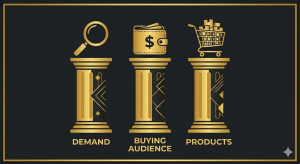
The Three Pillars of a Profitable Niche
Not every niche is created equal. Before committing to one, it needs to pass a three-part test:
- There Has to Be a Real Problem or Desire People need to be actively searching for solutions in this space. A niche only works if there’s genuine pain, passion, or aspiration driving people toward it. Ask yourself: are people spending money trying to solve this problem or fulfill this desire? If the answer is yes, you’re in the right territory.
- There Has to Be a Buying Audience Interest alone isn’t enough. Your niche needs people who are willing and able to spend money. Some niches have massive audiences but terrible conversion rates because the audience skews too young, too broke, or too casual. The sweet spot is a niche where people are actively looking for solutions and have the means to pay for them.
- There Have to Be Products to Promote or Create Whether you’re starting as an affiliate marketer or planning to create your own products, you need an ecosystem of offers to work with. Before locking in a niche, spend twenty minutes on ClickBank, Amazon, or Google to confirm that products, courses, and services already exist in that space. Existing competition is a green flag — it means money is already changing hands.
The Passion vs. Profit Debate
You’ve probably heard the advice “follow your passion.” You’ve also probably heard the counter-argument that passion doesn’t pay the bills. The truth is somewhere in the middle — and it’s more nuanced than either camp admits.
Passion matters because building an online business requires a lot of content creation, research, and audience engagement. If you pick a niche purely for profit potential but have zero genuine interest in it, you’ll burn out before you gain any traction. Showing up consistently for a topic you find completely boring is much harder than it sounds.
But passion alone isn’t enough either. There are plenty of passionate people in niches that simply don’t convert — hobbies with no spending culture, topics too narrow to sustain an audience, or markets already dominated by free resources.
The ideal niche sits at the intersection of three things: something you find genuinely interesting, something people are actively searching for solutions to, and something with a proven track record of commercial activity. Find that overlap and you’ve found your niche.
The Big Three Evergreen Markets
If you’re starting from scratch and aren’t sure where to begin, it’s worth knowing that the vast majority of successful online businesses operate within three broad evergreen markets:
- Health — Weight loss, fitness, mental health, longevity, specific conditions and treatments
- Wealth — Making money, investing, getting out of debt, side hustles, online business
- Relationships — Dating, marriage, parenting, communication, personal development
These markets have massive, passionate, spending audiences that never go away. The challenge is that they’re also competitive. The solution isn’t to avoid them — it’s to niche down within them. Instead of “weight loss,” try “intermittent fasting for people over 60.” Instead of “making money online,” try “affiliate marketing for retirees.” Specificity is your competitive advantage.

How to Validate Your Niche Before Committing
Before you build a website, create content, or invest any serious time, spend a few hours validating your niche idea. Here’s a simple validation checklist:
- Google your niche — Are there established blogs, YouTube channels, and websites already operating in this space? Good. That means there’s an audience.
- Check Amazon — Search for books on your topic. If people are buying books about it, they’ll buy other things too.
- Browse ClickBank or JVZoo — Are there digital products already selling in this niche? Check the gravity scores and sales rank to confirm active buying activity.
- Look at Facebook Groups and Reddit communities — Are people actively discussing this topic, asking questions, and seeking advice? Community activity is a strong signal of an engaged audience.
- Check keyword search volume — Use a free tool like Google Keyword Planner or Ubersuggest to see how many people are searching for terms related to your niche. High search volume means high demand.
If your niche passes most or all of these checks, you have your answer.
The Most Important Thing to Remember
Here’s what trips up more beginners than anything else: waiting for the perfect niche before getting started.
There is no perfect niche. Every niche has competition. Every niche has gaps. Every niche requires work. The cost of indecision is always higher than the cost of an imperfect choice, because at least an imperfect choice gets you moving — and movement creates learning that no amount of research ever can.
Pick a niche that passes the three-pillar test, that you can see yourself creating content about consistently, and that has a proven buying audience. Then start. You can always refine as you go.

Before you buy another money-making program, get the free Screenshot Reality Check: seven questions to ask first, plus a short video lesson on what income screenshots leave out. No hype.