
How Long Does It Really Take to Make Money Online?
It’s probably the most searched question in the entire online business space, and yet it’s the one that gets the most dishonest answers. Type it into Google and you’ll find a spectrum of responses ranging from “you can make money today” to “expect to wait two to three years before seeing significant results.” Both of those answers exist — and both are technically true in certain circumstances — which makes the question feel frustratingly unanswerable.
But it isn’t unanswerable. There is a realistic, honest framework for thinking about timelines in online business — one that accounts for the variables that actually determine how fast you’ll see results. This post is going to give you that framework, because understanding it is one of the most important things you can do before you start building.
Why the Question Is So Hard to Answer
The reason “how long does it take” feels impossible to answer definitively is that the timeline depends almost entirely on a set of variables that are different for every single person who asks the question.
Those variables include:
- Your business model. Some models produce income faster than others. Affiliate marketing through a blog takes longer than promoting an offer directly to a list you’ve already built. Freelancing produces income faster than building a passive content business.
- Your starting point. Someone who already has an audience, an email list, or a background in marketing will reach profitability faster than someone starting from absolute zero.
- The hours you invest. Someone building full time will see results faster than someone carving out five hours a week around a demanding job and family commitments.
- The quality of your execution. Consistent, strategic action produces results faster than sporadic bursts of activity separated by long periods of inaction.
- Your niche. Some niches are more competitive than others, and some have audiences more willing to spend money quickly.
- Your willingness to learn and adapt. People who treat their business like a real learning process — analyzing what works, adjusting what doesn’t, and continuously improving — compress their timelines significantly compared to those who keep repeating the same ineffective approaches.
With all of that said, let’s talk about what realistic timelines actually look like across the most common online business paths.
Timeline: Blogging and SEO
Of all the common online business models, blogging with an SEO strategy is one of the slowest to produce income — and one of the most rewarding once it does.
Here’s a realistic picture:
- Months one through three: Setting up the site, publishing your first batch of content, establishing your niche focus. Little to no traffic. Income: essentially zero.
- Months four through six: Early search rankings begin to appear for lower-competition keywords. Traffic starts to trickle in. First affiliate commissions may appear — typically small and inconsistent.
- Months seven through twelve: Traffic grows as more content ranks and older content builds authority. Email list begins to grow meaningfully. Affiliate income becomes more consistent. Some bloggers reach their first few hundred dollars per month in this window.
- Year two and beyond: Compound growth kicks in. Established content continues to rank, new content ranks faster due to site authority, and income can scale significantly for those who stay consistent.
The honest truth about blogging: most bloggers who succeed didn’t see meaningful income until month nine to eighteen. Most bloggers who quit did so at month three to six — right before things started to turn.

Timeline: YouTube
YouTube has a similar compounding dynamic to blogging, with a few key differences. Growth on YouTube tends to be less linear — channels can plateau for months and then experience sudden surges in subscribers and views triggered by a single video performing well in the algorithm.
- Months one through three: Building the channel, finding your voice, publishing consistently. Subscribers grow slowly. Income: minimal.
- Months four through six: If you’re publishing consistently and optimizing your titles and thumbnails, you’ll start to see which topics perform best. Early subscriber growth begins to accelerate.
- Months seven through twelve: Channels that have published consistently and found their niche begin to see real momentum. The YouTube Partner Program requires 1,000 subscribers and 4,000 watch hours — many dedicated creators reach this between months six and twelve.
- Year two and beyond: Established channels with a library of content benefit enormously from YouTube’s search and suggested video algorithm. Income from AdSense, affiliate links, and product promotions can become substantial.
Timeline: Affiliate Marketing Without a Blog or Channel
Some affiliate marketers promote offers directly — through solo ads, social media, or paid traffic — without building a content platform first. This approach can produce income faster, but it’s also less sustainable and requires either a budget for paid traffic or an existing audience.
With a small paid traffic budget and a well-chosen offer, it’s possible to generate your first commissions within days or weeks. However, without building an audience or an email list in parallel, this approach doesn’t compound over time the way content-based strategies do.
Timeline: Digital Products and Online Courses
Creating and selling your own digital products — ebooks, templates, courses, or membership sites — takes longer to set up than affiliate marketing but offers higher profit margins and greater control.
Realistically, expect to spend one to three months creating your first product and setting up the infrastructure to sell it. Revenue then depends almost entirely on your ability to drive traffic and build an audience around the product. Creators who already have an audience can generate significant revenue from a launch. Those starting from scratch will need to build that audience first, which adds to the timeline.
The Most Honest Answer
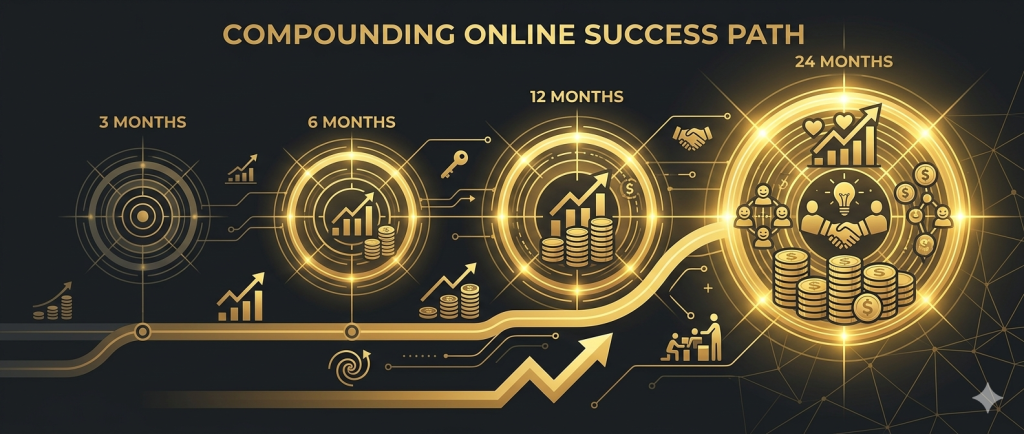
If you are starting from absolute zero — no existing audience, no email list, no prior experience in online marketing — and you are building a content-based online business part-time with a consistent effort of ten to fifteen hours per week, here is the most honest timeline I can give you:
- First commission or sale: One to three months
- First $100 month: Three to six months
- First $500 month: Six to twelve months
- First $1,000+ month: Twelve to twenty-four months
- Full-time income replacement: Two to four years for most people, faster for those who execute exceptionally well or invest heavily in paid traffic
These are not guarantees. They are honest estimates based on what consistent, strategic effort typically produces. Some people will hit these milestones faster. Many will take longer. A handful will never reach them because they stop before compounding kicks in.

How to Compress Your Timeline
There are legitimate ways to accelerate your results without resorting to shortcuts that don’t work:
- Publish more content, more consistently. Volume and consistency are among the strongest predictors of faster results in content-based businesses.
- Build your email list aggressively from day one. Every subscriber you capture shortens the timeline to your next sale.
- Choose a less competitive niche or sub-niche. Ranking faster in a narrower niche accelerates the early stages significantly.
- Invest in education strategically. One well-chosen course or mentorship that solves a specific problem you’re facing can save months of trial and error.
- Reinvest early revenue into paid traffic. Even a small paid traffic budget, once your funnel is proven, can meaningfully accelerate growth.
- Study your analytics relentlessly. Knowing what’s working and doubling down on it is one of the highest-leverage activities in any online business.

The Mindset That Makes the Difference
More than any strategy or tool, the single biggest factor in how quickly you build an online income is your willingness to commit to a realistic timeline and stay the course within it.
The people who succeed are not always the most talented or the most strategic. They are almost always the most persistent. They treat slow months as data, not defeat. They treat setbacks as feedback, not failure. And they keep showing up long after most people have given up.
Set your expectations honestly. Plan for a journey measured in months and years, not days and weeks. And then work within that timeline with the kind of consistency and focus that makes compounding possible.
The results, when they come, are worth every bit of the wait.
For weekly insights, strategies, and honest advice on building real online income, join the Profit With Bob newsletter. No hype, no empty promises — just actionable content from someone who’s been in the trenches. [Subscribe here.]