Why Email Marketing Is Still the #1 Most Profitable Online Channel
Heads up: this post may contain affiliate links. If you buy through them, I may earn a commission at no extra cost to you. I only recommend what I’d use myself. Full disclosure
Why Email Marketing Is Still the #1 Most Profitable Online Channel
Every few years, someone publishes a think piece declaring that email marketing is dead. Social media has replaced it, they say. Younger audiences don’t check their inboxes. Attention has moved to short-form video and messaging apps. Email is a relic of a previous era of the internet that no longer reflects how people actually communicate or consume content.
And every few years, the data says the same thing in response: email marketing is not dead. It is, by almost every measurable metric, the most profitable digital marketing channel in existence — and has been consistently for decades.
This post is going to explain why that’s the case, why it’s unlikely to change anytime soon, and what it means for how you should be prioritizing your time and energy as you build your online business.
The Numbers Don’t Lie
Let’s start with the data, because it’s genuinely striking.
Email marketing consistently generates an average return on investment of between $36 and $42 for every dollar spent — figures that dwarf the ROI of virtually every other digital marketing channel. Social media advertising, content marketing, SEO, paid search — all of them trail email by a significant margin when measured on a pure return basis.
The email channel also reaches more people more reliably than social media. The average organic reach of a Facebook post is somewhere between two and six percent of a page’s followers — meaning that if you have ten thousand Facebook followers and you publish a post, somewhere between two hundred and six hundred people might actually see it. Send an email to ten thousand subscribers and — depending on your list quality and subject line — somewhere between twenty and forty percent of them will open it. That’s four to twenty times the reach of a social media post to the same audience size.
And the email user base continues to grow. There are currently over four billion email users worldwide — a number that continues to increase year over year. Email is not a declining channel. It is a growing one.
Why Email Outperforms Every Other Channel
The raw numbers are impressive, but they don’t fully explain why email is so consistently effective. To understand that, you have to look at what email actually is — and what it isn’t.
Email is permission-based. Every person on your email list chose to be there. They opted in, confirmed their subscription, and gave you explicit permission to communicate with them. That consent creates a fundamentally different relationship than the one you have with social media followers, who may have clicked a follow button impulsively and now barely notice your posts in their feed. An email subscriber is someone who raised their hand and said yes — I want to hear from you.
Email is personal. When an email arrives in someone’s inbox, it feels like a direct communication — even when it was sent to thousands of people simultaneously. The inbox is a personal space in a way that a social media feed simply isn’t. People read emails with a different level of attention and engagement than they scroll through social media content.
Email is not algorithm-dependent. This is one of the most strategically important advantages of email and one that is easy to underestimate until you’ve experienced the pain of an algorithm change devastating your organic reach overnight. When you send an email, it goes to your subscriber’s inbox. No platform decides whether it’s worth showing. No feed ranking system deprioritizes it. The only gatekeeper is the spam filter — which a well-maintained list and a good sending reputation largely neutralize.
Email builds relationship depth over time. A subscriber who has been receiving your weekly emails for six months knows you in a way that a social media follower who sees your occasional posts never will. They’ve read your insights, heard your perspective, received your recommendations, and built up a reservoir of trust through consistent, valuable interaction. That depth of relationship is what makes email subscribers so much more likely to buy than almost any other type of audience.
Email converts at higher rates. Across virtually every type of offer — affiliate products, digital courses, coaching programs, software subscriptions — email traffic converts at significantly higher rates than social media traffic or cold search traffic. The combination of permission, personalization, and relationship depth creates a buyer-readiness that other channels simply can’t replicate.
The Inbox as Prime Real Estate
There’s a real estate analogy that captures something important about the email inbox. In physical retail, the most valuable location is the one with the highest foot traffic and the greatest visibility — the storefront on the busiest corner of the most desirable street. Online, the most valuable piece of real estate you can occupy is your subscriber’s inbox.
Unlike a social media feed — where your content competes with hundreds of other posts, advertisements, trending topics, and algorithmic insertions — the inbox is a focused, intentional space. People go to their inbox with purpose. They’re there to engage with the messages they find there, not to passively scroll and hope something catches their eye.
When you occupy that space with consistent, valuable content, you are not competing for attention in the way that social media requires. You are being invited into a conversation that your subscriber chose to have with you. That is an extraordinary privilege — and one that translates directly into engagement, trust, and revenue when handled with care and consistency.
What the Alternatives Can’t Offer
To fully appreciate what email marketing provides, it helps to examine what the alternatives cannot.
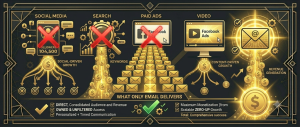
Social media gives you reach — sometimes enormous reach — but it gives you borrowed reach on someone else’s platform, subject to someone else’s rules and someone else’s algorithm. The organic reach of social media content continues to decline as platforms prioritize paid advertising. Your social media following is an audience you rent. Your email list is an audience you own.
SEO and search traffic can drive significant volume to your website, but it’s impersonal. A search visitor who lands on your blog post is a stranger encountering your content for the first time. The conversion potential is real but limited compared to a warm email subscriber who has received value from you repeatedly.
Paid advertising can deliver targeted traffic quickly, but it stops the moment the budget runs out. It also requires continuous spending to maintain results and demands significant expertise to run profitably. Email, by contrast, is a channel where the asset — your list — grows and compounds over time, delivering returns that increase as the list grows without requiring proportional increases in spending.
Podcasting and YouTube build audiences with genuine depth and loyalty — probably the closest alternatives to email in terms of relationship quality. But neither offers the direct response capability of email. You cannot send a time-sensitive offer to your YouTube subscribers at nine in the morning and expect them to see it by noon. With email, you can — and that direct response capability is at the heart of email’s revenue-generating power.
Email Marketing in the Age of AI and Automation
One of the most exciting developments for email marketers in recent years is the way artificial intelligence and automation tools have dramatically expanded what’s possible with a modest list and limited resources.
AI-assisted copywriting tools can help you produce compelling email content faster than ever. Sophisticated automation platforms allow you to create complex behavioral sequences — emails triggered by specific subscriber actions, interests, or purchase history — that deliver hyper-relevant content without requiring manual intervention for every send. Personalization capabilities that once required enterprise-level resources are now accessible to individual online business owners.
The result is that a single person with a modest email list, the right tools, and a thoughtful automation strategy can generate revenue at a scale that would have required a full marketing team just a decade ago. The ceiling for what’s achievable with email marketing has never been higher — and the floor for what’s required to get started has never been lower.
Common Objections Addressed
Let’s take a moment to address the most common objections to prioritizing email marketing.
“My audience is younger and doesn’t use email.” This is a persistent myth that the data consistently refutes. Email usage rates are high across all demographic groups, including millennials and Gen Z. The idea that younger people don’t use email conflates the communication preferences of teenagers with the professional and commercial behavior of adults in their twenties and thirties — two very different things.
“Open rates have been declining.” It’s true that average open rates have changed over time and that tracking open rates has become more complex with changes to email privacy settings. But engagement metrics beyond open rates — click-through rates, conversion rates, revenue per email sent — continue to demonstrate email’s effectiveness as a revenue channel.
“Social media has more reach.” Reach and quality of engagement are different things. Reaching ten thousand people with a two percent engagement rate produces different results than reaching two thousand people with a thirty percent engagement rate. Email wins on engagement quality by a margin that more than compensates for any differences in raw reach.

The Bottom Line
Email marketing is not dead. It is not declining. It is not being replaced by social media, messaging apps, or short-form video. It is the most consistently profitable digital marketing channel available to online business owners — and has been for decades.
If you are not building an email list, you are leaving the most valuable marketing channel available to you entirely untapped. If you are building one but treating it as an afterthought, you are underutilizing an asset that could be the most reliable revenue driver in your entire business.
Prioritize email. Build your list. Nurture it consistently. And let the most proven channel in digital marketing do what it has always done best — build relationships that convert into revenue.
Join the Profit With Bob newsletter for weekly strategies, insights, and no-fluff advice on building real online income through email marketing and beyond. [Subscribe here.]